
News
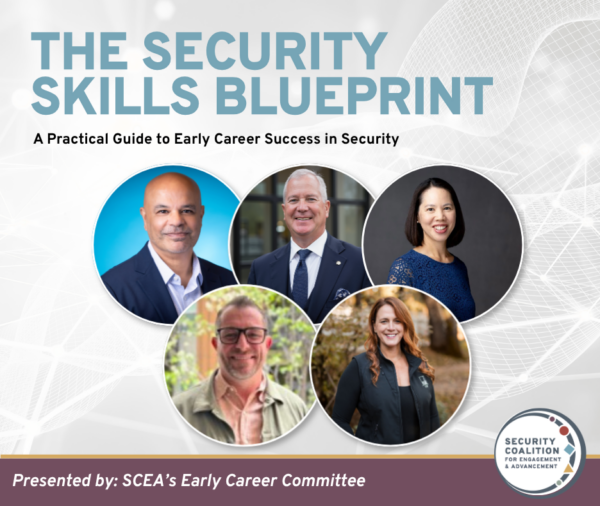
The Security Skills Blueprint: A Practical Guide to Early Career Success in Security
What does it take to build a successful career in today’s security profession?
For years, the answer seemed straightforward: develop technical expertise, earn certifications, and stay current with emerging threats and technologies. Those things still matter. But as security roles continue to evolve, the definition of a successful security professional is evolving with them.
That reality was at the center of SCEA’s recent Security Skills Blueprint webinar, where security leaders from across the industry shared insights on the skills, experiences, and mindsets that shape career growth in today’s profession.
Hosted by SCEA’s Early Career Committee, the webinar reflected the committee’s mission to support individuals entering the security profession by helping them navigate career pathways, access professional networks, and connect with mentorship and educational opportunities. Through conversations like these, the committee aims to equip emerging professionals with the resources, confidence, and industry insight needed to build successful long-term careers in security.
While panelists represented different organizations, backgrounds, and career journeys, a clear theme emerged throughout the discussion: technical skills may open doors, but they are rarely the factor that determines long-term success.
Here are five key takeaways from the conversation.
1. Technical Skills Open Doors, But They Don’t Build Careers
One of the strongest messages from the discussion was that technical proficiency alone rarely determines who advances.
Today’s security professionals are increasingly expected to collaborate across functions, influence decision-makers, and communicate risk in ways that resonate with different audiences. Success is no longer defined solely by what someone knows. It is also shaped by how effectively they can apply that knowledge, explain it to others, and help organizations make informed decisions.
As security becomes more integrated with business operations, professionals who can bridge the gap between technical concepts and organizational priorities are often the ones who create the greatest impact.
Communication surfaced repeatedly throughout the conversation, not as a “soft skill,” but as a core professional competency. Whether presenting to executives, partnering with business leaders, or working alongside operational teams, the ability to translate complexity into clarity is becoming increasingly valuable.
Technical expertise remains the foundation. But it is rarely the entire blueprint.
2. Curiosity Is a Competitive Advantage
Curiosity is often discussed as a personality trait. During the webinar, it emerged as something more practical: a career strategy.
The security landscape changes constantly. New technologies introduce new opportunities and new risks. Threats evolve. Organizations adapt. In that environment, professionals who remain curious are often better positioned to grow alongside the profession itself.
That curiosity extends beyond formal training or certifications. It shows up in asking thoughtful questions, seeking out unfamiliar experiences, and exploring challenges from multiple perspectives.
The professionals who continue to grow are often the ones who remain students of the profession, regardless of how much experience they have already accumulated.
For early-career professionals, curiosity can be one of the most powerful differentiators. Technical skills can be taught. A genuine desire to learn often opens doors that credentials alone cannot.
3. Learn How the Business Creates Value
Security does not exist for its own sake. It exists to support and protect the organization’s mission.
That may sound obvious, but it was a point that surfaced repeatedly throughout the discussion.
Security professionals sometimes assume that a technically sound recommendation should speak for itself. In practice, it rarely does. Decisions are often influenced by operational realities, business priorities, financial considerations, and competing organizational needs.
Understanding those realities helps security professionals become more effective advocates for security outcomes.
It also helps build credibility. Leaders who understand how the business operates, generates value, and measures success are often better equipped to influence decisions and build partnerships across the organization.
The conversation reinforced a simple but important idea: the most effective security professionals understand both security and the environment in which security operates.
4. Apply Your Skills, Don’t Just Collect Credentials
Certifications can open doors and validate knowledge. They are valuable tools for professional development, but they are not substitutes for experience.
Throughout the webinar, panelists emphasized the importance of applying knowledge in real-world situations. Hiring managers and leaders are ultimately looking for evidence that someone can solve problems, think critically, and navigate ambiguity.
That experience can come from many places. It may come through internships, volunteer work, special projects, mentorship opportunities, cross-functional assignments, or responsibilities taken on outside of a formal role.
What matters most is not simply what someone has learned. It is what they have done with that knowledge.
For professionals entering the field, that distinction can be encouraging. Building credibility often starts with taking initiative and finding opportunities to contribute, even before a perfect opportunity presents itself.
5. Career Paths Are Rarely Linear
One of the most reassuring aspects of the discussion was how different each panelist’s career journey had been.
No single path emerged. Some entered the profession through traditional routes. Others arrived through adjacent disciplines, unexpected opportunities, or experiences that initially seemed unrelated to security.
The diversity of those journeys served as a reminder that successful careers are often shaped less by following a predetermined roadmap and more by remaining open to growth opportunities as they arise.
Skills developed in one role frequently become valuable in another. Experiences that seem disconnected at one stage of a career often prove unexpectedly relevant later.
For professionals early in their careers, that perspective can help shift the focus away from finding the “perfect” path and toward building a foundation of skills, relationships, and experiences that support long-term growth.
The Blueprint Is Bigger Than a Technical Skill Set
The conversation ultimately challenged a common assumption about career development in security.
Success is not built solely on technical expertise. It is built on the ability to continually learn, communicate effectively, understand the business, build strong relationships, and adapt as the profession evolves.
Technical skills remain essential, but they are only one part of a much broader professional toolkit.
In that sense, the modern security skills blueprint is not a checklist. It is a mindset.
And for professionals just beginning their careers, that may be the most valuable lesson of all.
To hear the full conversation and gain additional insights from the panel, watch the recording of SCEA’s Security Skills Blueprint webinar. To learn more about SCEA’s Early Career Committee and its efforts to support the next generation of security professionals through mentorship, education, and career development opportunities, visit the committee’s webpage.